🌸 Persephone: From Flower Girl to Queen of the Underworld
The surprising story behind the goddess of spring, death, and everything in between.
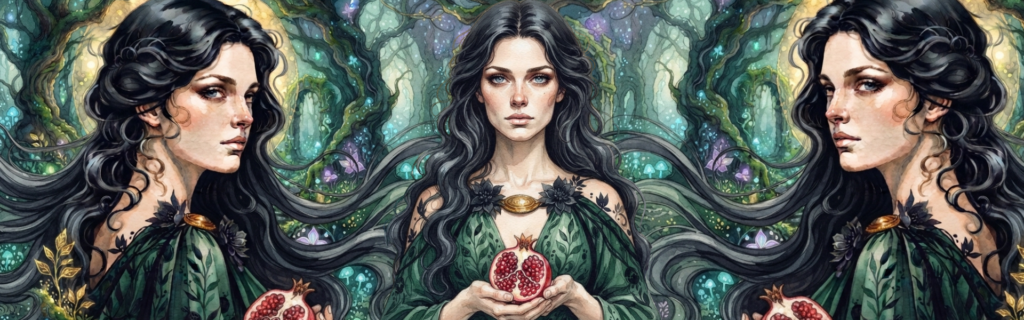
If you know anything about Greek mythology, you probably know Persephone as the goddess of spring.
Flowers bloom when she returns.
Winter comes when she leaves.
But the original story is much stranger than the version we usually hear.
Because before Persephone became Queen of the Underworld, she was simply a daughter who disappeared.
🌼 The Daughter of Demeter
Persephone was the daughter of Demeter, the Greek goddess of agriculture and the harvest.
Hades, the god who ruled the Underworld, wanted Persephone to become his wife.
So he went to his brother, Zeus, and asked for permission.
Zeus agreed.
And this is where things get uncomfortable.
Zeus made the arrangement without telling Demeter.
According to the ancient Homeric Hymn to Demeter, Zeus allowed Hades to take Persephone because Hades wanted a wife and Zeus had the authority to approve the marriage.
There was no romantic proposal.
No family meeting.
Instead, Hades went to get Persephone.
⚡ The Disappearance
One day, Persephone was outside picking flowers when suddenly the earth opened beneath her.
Hades came bursting out of the Underworld in his chariot, seized Persephone, and carried her away.
Then the earth closed behind them.
Persephone was gone.
Demeter searched everywhere for her daughter, carrying torches through the night.
Eventually, she discovered the truth:
Hades had taken Persephone.
And Zeus had allowed it.
Demeter was furious.
But she was also the goddess of agriculture.
So she stopped making the earth produce crops.
The harvest failed.
The fields became barren.
Humans began to starve.
Basically, Demeter’s grief became everyone’s problem.
And suddenly, Zeus had to fix the mess he helped create.
🍎 The Pomegranate Problem
Zeus sent Hermes, the messenger god, to the Underworld to bring Persephone home.
But before she left, Hades gave Persephone a pomegranate.
She ate some of it.
And that tiny detail changed everything.
In the ancient story, eating food from the Underworld meant Persephone could not simply return to the world above forever.
So Zeus came up with a compromise.
Persephone would spend part of the year in the Underworld and part of the year with her mother.
When Persephone returned, Demeter allowed the earth to bloom.
When Persephone left, Demeter’s grief returned.
And from this story came an ancient Greek explanation for the changing seasons.
🍎 Wait… How Many Seeds?
You’ve probably heard that Persephone ate six pomegranate seeds, which is why she spends six months in the Underworld.
There’s just one problem.
The oldest surviving version doesn’t say that.
The Homeric Hymn to Demeter says Persephone ate pomegranate, but it doesn’t give us the famous six-seed explanation.
Instead, it says Persephone would spend one-third of the year in the Underworld and the other two-thirds with her mother.
So where did the six-month version come from?
Mythology happened.
Different writers and communities retold these stories, and details changed over time.
Which means there isn’t always one single “correct” version of a myth.
And honestly, that’s part of what makes mythology so interesting.
👑 From Flower Girl to Queen
Here’s the part that often gets overlooked.
Persephone doesn’t simply return home and go back to being the girl who picks flowers.
She becomes Queen of the Underworld.
In the ancient story, Hades tells Persephone that she will have authority and honor among the dead.
She is no longer simply the daughter caught between two powerful gods.
She has power of her own.
Persephone becomes connected to two worlds that seem completely opposite:
🌸 Life, growth, and spring
💀 Death and the Underworld
And that makes her story much more complicated than simply calling her “the goddess of spring.”
A seed disappears beneath the earth before a plant can grow.
Crops are harvested and planted again.
The earth seems to die and come back to life.
Persephone stands right in the middle of that cycle.
She isn’t just a goddess of spring.
She’s a goddess of what comes after.
🚨 AP Exam Takeaway (Keep This for Your Notes!)
Historical Reasoning Skill: Contextualization
The story of Persephone and Demeter comes from a society where agriculture was essential to survival. Understanding that context helps explain why ancient Greeks connected Persephone’s disappearance and return to the fertility of the earth and the changing seasons.
When analyzing a historical source, ask:
What was happening in the society when this source was created, and how might that historical context have influenced the ideas expressed in the source?
AP Connection: On the AP exam, contextualization means explaining how a historical development or source can be understood in the context of the broader historical circumstances surrounding it.
Persephone’s story isn’t just a myth about the seasons. It reflects the importance of agriculture in ancient Greek society and the way people used stories to make sense of the natural world around them.

🎭 Bring This Drama to Your Classroom! The gossip is fun, but letting your students act it out hits different. If you want to bring this exact chaotic energy into your next history or English lesson, skip the boring lectures.

Want to bring these myths to life? Grab our Readers Theater Script Set featuring two exclusive scripts: Persephone: Queen of the Underworld and Echo & Narcissus!
Still craving more Greek mythology drama? Grab the fan-favorite Greek Gods Spill the Tea!