MEDUSA WASN'T
ALWAYS
THE MONSTER
The story behind one of Greek mythology’s most misunderstood figures.
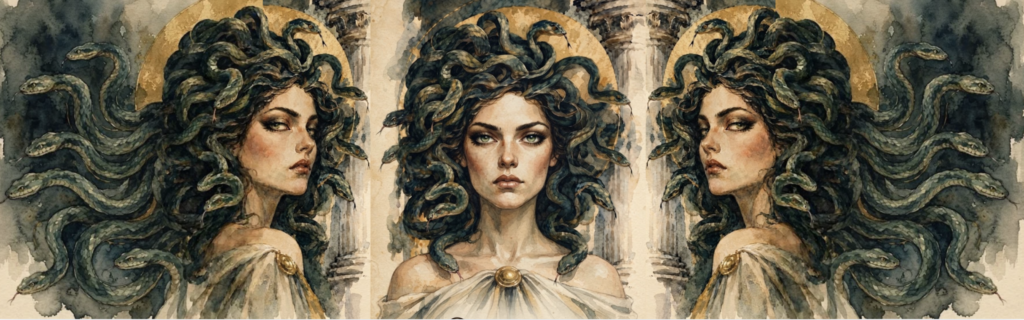
Let’s be real: history did Medusa dirty.
If you ask the average person who Medusa is, they’ll probably tell you she’s a terrifying, snake-haired monster who can turn you to stone just by looking at you.
Monster. Snakes. Stone.
Case closed.
Except… not exactly.
Here’s the historical tea: Medusa wasn’t always the monster.
🐍 The Original Medusa
One of the earliest surviving Greek accounts of Medusa comes from the poet Hesiod.
And Hesiod’s Medusa?
She’s already a monster.
Medusa is one of three Gorgon sisters, and she’s the only one who is mortal. There is no beautiful-priestess backstory. No dramatic transformation.
She’s a monster from the beginning.
Then, centuries later, the Roman poet Ovid gave Medusa a completely different story.
According to Ovid, Medusa was originally a beautiful mortal woman and a priestess of Athena.
Basically, she was serving Athena…
and serving looks.
Then Poseidon, the literal god of the sea, entered the story and everything went sideways.
Medusa had a troubling encounter with Poseidon inside Athena’s temple. Afterward, Athena transformed Medusa’s beautiful hair into a nest of literal snakes and gave her a gaze that could turn anyone who looked directly at her into stone.
And that, my friends, is how you get looks that kill.
Okay, we can’t actually give Medusa credit for inventing that phrase.
But if anyone has earned it, it’s her.
👀 Wait… Athena Was Jealous?
Here’s where the story gets even juicier.
You’ve probably heard that Athena was jealous of Medusa’s beauty.
Sounds believable.
Very Greek mythology.
Except Ovid doesn’t actually say Athena was jealous.
He tells us Medusa was beautiful. He tells us what happened in Athena’s temple. And he tells us Athena transformed her.
The jealousy explanation became part of later retellings.
So the Medusa story most people know today isn’t necessarily the original Greek version.
It’s a rewrite.
And that means the question isn’t simply, “What’s the real story?”
It’s:
“Who told it?”
Hesiod’s Medusa was a terrifying Gorgon.
Ovid’s Medusa had a completely different origin story.
Later storytellers added even more.
Same character. Very different story.
🫖 And Then Athena Gets the Last Word
Just when you think Medusa’s reputation can’t get any more complicated, here’s another piece of tea:
Ancient Greeks also used Medusa’s terrifying face as a symbol of protection.
Her image, called a gorgoneion, appeared on shields, pottery, buildings, and other objects to ward off evil.
Basically, the ancient Greeks looked at Medusa and said:
“She’s horrifying. Put her on the shield.”
And here’s the wild part:
After Perseus killed Medusa, her severed head eventually became part of Athena’s own protective imagery.
So the goddess who punished Medusa ended up displaying Medusa’s terrifying face on her armor.
The Olympian justice system was not exactly winning awards.
🫖 The Real Gossip
Medusa’s story wasn’t simply passed down unchanged for thousands of years.
It evolved.
A Greek poet gave us one Medusa.
A Roman poet gave us another.
Later storytellers gave us even more.
So the next time someone tells you they know the “real” story of Medusa, ask one question:
“Which version?”
Because sometimes the most interesting part of history isn’t just the story.
It’s who got to tell it.
🚨 AP Exam Takeaway (Keep This for Your Notes!)
Historical Reasoning Skill: Sourcing
Medusa’s story is a great example of why who created a source matters. The Greek poet Hesiod and the Roman poet Ovid told very different versions of Medusa’s story, centuries apart.
When analyzing a historical source, ask:
Who created it? When? Why? And how might the author’s perspective influence what they wrote?
AP Connection: On the AP exam, sourcing means explaining how a source’s point of view, purpose, historical situation, or audience can affect the way it presents historical events or ideas.
🎭 Bring This Drama to Your Classroom! The gossip is fun, but letting your students act it out hits different. If you want to bring this exact chaotic energy into your next history or English lesson, skip the boring lectures.
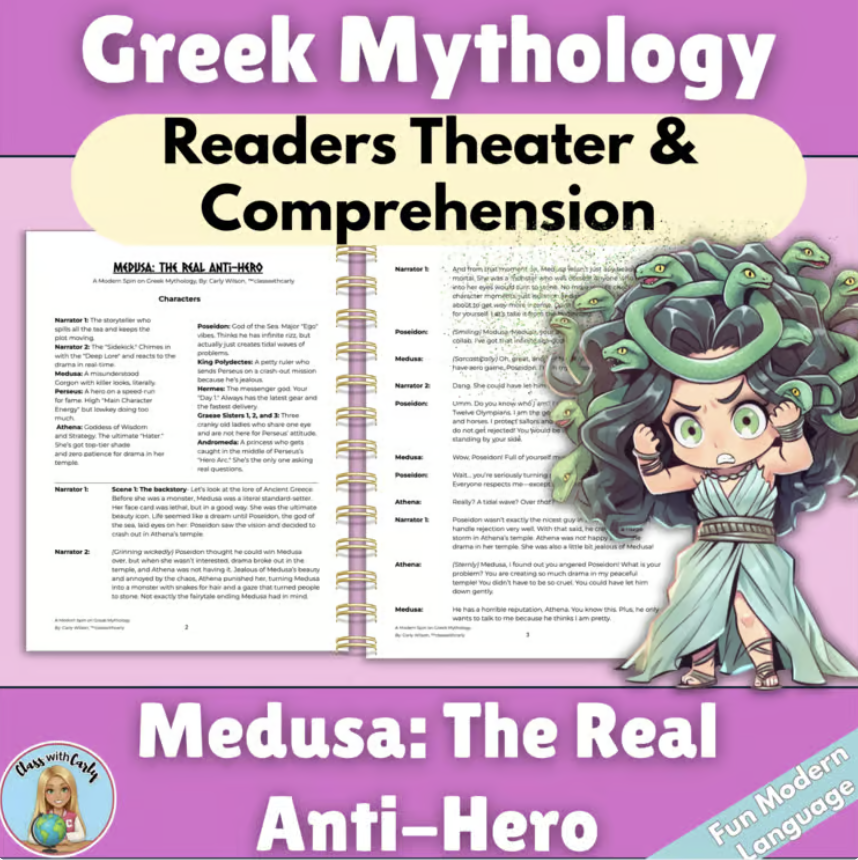
Grab our Medusa Readers Theater Script to turn this myth into an interactive classroom experience where students voice the gods and decide who the real villain is.
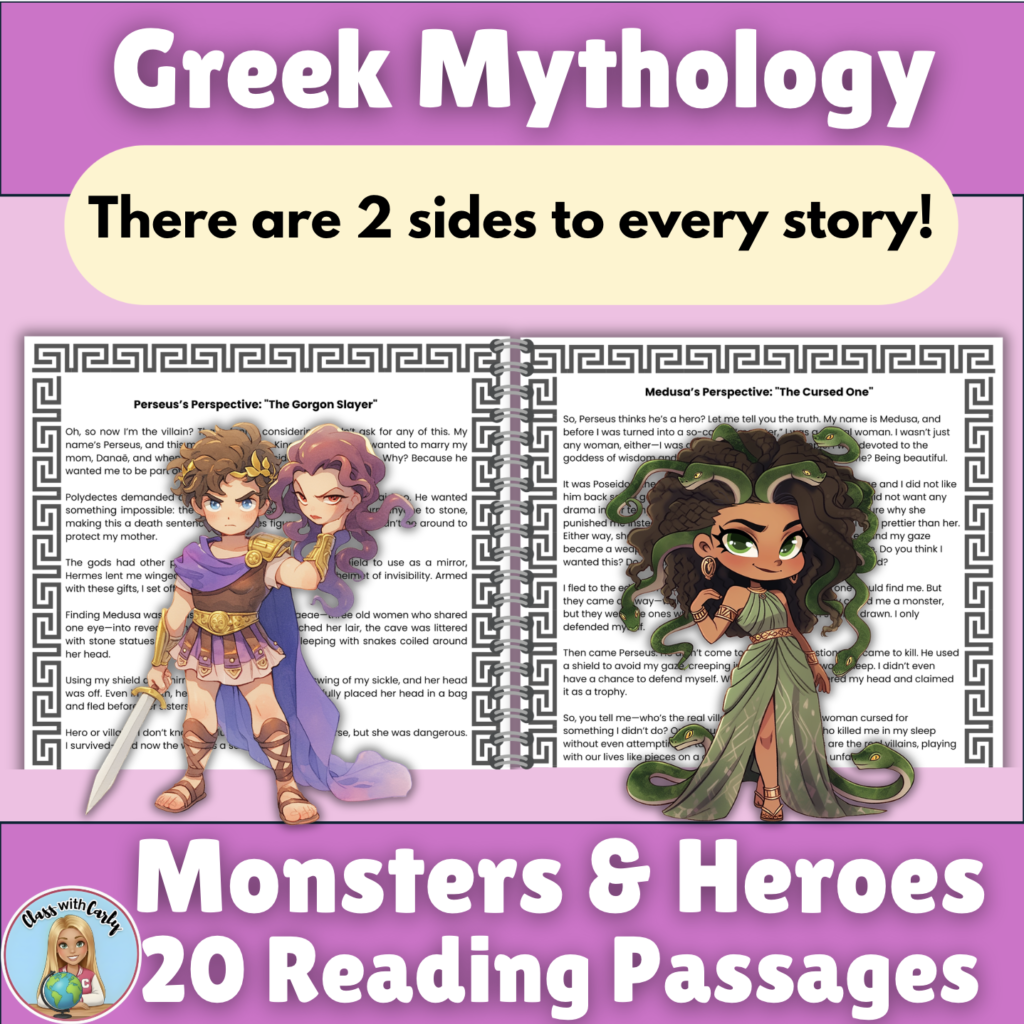
As you can see, there are two sides to every store. So who is really the monster and who is really the hero? You decide!